Search J & A Abroad

Showing posts with label Cambodia. Show all posts

Friday, December 2, 2011

The Temples of Angkor

Much like the Great Wall of China and the Great Barrier Reef, the (great) ruins of Angkor did not disappoint us despite being so full of hype and expectations.  Also like the Wall and the Reef, it is difficult to explain what made visiting the ruined Angkor temples so special.  Photos don't really do the crumbling sandstone blocks and overgrown structures justice, and words can't quite convey the sense of history and mystery the decaying splendor of Angkor and it's 300 plus temple ruins give off.  The temples are very photogenic, but their full scale and brilliant detail don't translate in photographs.  Standing below, around, and in some of the most impressive existing structures from any ancient civilization, it is easy to imagine the former glory that was the Angkor civilization even as the temples lay in ruins.  Anytime the old, collapsed version of something makes you stop and ponder in amazement, you know something impossible was built there long ago.  We often just stared in awe, imagining the temples in their heyday.

The oldest temples date from the 9th century, while some of the most famous, including Angkor Wat, were constructed in the 12th century.  The Angkor civilization spanned from the 9th to the 15th century and during that time some 30 plus kings attempted to out-do one another by building their own temples.  The result is over 300 beautifully collapsing and rebuilt versions of temples about six kilometers from Siem Reap. The temples have a fascinating combination of Hindu and Buddhist influences, and sometimes one religion would be removed from a temple entirely and replaced with the other.

Our lovely guide Kanha

One way to see the Angkor temple area, and the way that worked well for us, was to hire a tuk tuk driver and a tour guide for the day.  The tuk tuk allows you to see more and rest your feet once and a while (and the breeze of an open-air tuk tuk is heaven-sent on those very hot days!), and the (English speaking) tour guide allows you to gain a deeper understanding of what you are looking at.  The temples and ruins are all very beautiful and alluring, but without a guide it is difficult to grasp the finer details, history and meaning of the temples.  As we've mentioned before, the number one rule when sightseeing with a tour guide is that the sight is only as good as the guide.  Angkor Wat might be an exception, but the rest of the temples in the Angkor area (and our day as a whole) were vastly improved by our excellent tour guide, Kanha (pronounced Khan-Ya).  She was the perfect blend of friendly, informative, and funny.  Although we learned somethings about the Angkor temples from Kanha, our favorite conversations with her were more personal ones about her family and about us.  Kanha has three siblings, the oldest of which (her big sister) was taken from the family by the Khmer Rouge to a "reeducation camp" when she was a child (thankfully, she was reunited with her family not long after).  The highlight of the day was sitting in Angkor Wat for a half hour talking about Seattle, Cambodia, her life, and ours - everything but the temples.

Our conversations and day with Kanha aren't to say that we didn't enjoy exploring and learning about Angkor Wat and the other temples we visited.  Kanha added an additional level of interest with stories and descriptions of things we would have otherwise just stared stupidly at, and perhaps flicked a meaningless photo of.  We were accompanied on our second day at Angkor by a different guide, Kanha's friend Ra.  Kanha had another group coming in to town, so she was unable to show us around on our second day, but her friend Ra was a great guide too.  Ra was maybe a bit more history, story, and information focused, which was a good contrast following our friendship bonding day with Kanha.  We learned in more detail about each site we visited with Ra, though he also talked a bit about his personal and family history growing up during the time of the Khmer Rouge and the civil wars that plagued Cambodia from 1979 to 1999. 


The best way to summarize our two days at Angkor might be a quick breakdown of our favorite sites:


Ta Prohm
Featured in the film Tomb Raider, Ta Prohm looks like something straight out of Indiana Jones.  The temple has been left much as it was when the first Europeans stumbled upon it, overgrown and crumbling.  Some trees seem to grow right out of the temple itself and they seem to be winning in the age-old battle of man(made) versus nature.


Angkor Thom (Ancient City)
This enormous ancient city was the center of the Angkor empire.  It was a bustling city of over 1 million back when London had around 55,000 people!

Bayon
This is one of the most famous temples around Angkor for its countless four-sided Buddha face towers.  Bayon was Jeff's favorite temple and the best, just before Ta Prohm, for taking awesome photos. 

Baphuon 
Some have called this the world's largest jigsaw puzzle.  Archeoligists deconstructed it before the civil war but their progress was interrupted by the Khmer Rouge.  Now, twenty-five painstaking years later, it has been put back together after no shortage of sweat and difficulty.


Angkor Wat
What can we say?  Angkor Wat is one of the world's most famous man-made structures, and for good reason.  It is impressive from far away, close up, from above, from below, and especially at sunrise (a typical sunrise at Angkor Wat brings about 1,000 tourists out at about 5:30 am).  The remarkably large and detailed carvings detailing ancient stories and histories of Angkor were as awesome to look at as the enormous temple itself.


Sunrise at Angkor Wat
Beautiful! Astounding! Breathtaking! Totally worth getting up at 4:30am to see (and Annette wouldn't say that about many things).

Landmine Museum
Though not officially part of the Angkor complex, this nearby museum told the story of Aki Ra, the founder of the museum and several other impressive ventures.  His is a truly heroic and amazing tale.  It is hard to do his life's work justice here, but we'll gladly tell you what we learned sometime over dinner or a beer.  In short, he has spent the second half of his life finding and disarming landmines and Unexploded Ordinances (UXO) that plague Cambodia's rural areas.  He spent the first part of his life as a child soldier for the Khmer Rouge planting many of those same landmines.  Most estimates put the number of landmines and UXO that dot Cambodia's countryside at about 6 million.  Aki Ra has disarmed over 50,000 of what remain himself, and heads his own de-mining organization as well as founding a school and safe-haven for young victims of landmines.  He is truly a hero and an inspiration, and his museum is an excellent introduction to his work and the many ways the civil war and Khmer Rouge (and the relentless bombing of Cambodia during the Vietnam war) still affect Cambodian's everyday lives.

Thursday, December 1, 2011

A Visit to Tuol Sleng: Face to Face with Cambodia's Past

We were shocked by Phnom Penh's chilling Tuol Sleng Genocide Museum and how quickly it brought us face to face with Cambodia's tumultuous past.  We are a little embarrassed to admit how little we knew about the Khmer Rouge and the terrible crimes they committed between 1975 and 1979 before we came to Cambodia.  The four years under the Khmer Rouge and its infamous leader, Pol Pot, according to most estimates, saw around 2 million Khmers (Cambodians) lose their lives to murder, famine, and disease.  The short reign of the Khmer Rouge and the pain and suffering that followed their collapse define Cambodia in more ways than one.  And getting closer to Cambodia's past in Phnom Penh did give us the framework we needed to really connect with and understand what Cambodia has been through and where the country is today. 

Our first major introduction to the evils of the Khmer Rouge regime was at the Tuol Sleng Genocide Museum.  The strengths of this museum are its location and understated seriousness.  The museum is housed in the infamous S-21 Prison, where only twelve people survived out of an estimated 17,000 prisoners who passed through its gates between 1975 and 1979.  The prison was converted from a high school in 1975, soon after the Khmer Rouge came to power; its main purpose was to torture inmates into giving confessions against themselves and their family and friends.  If inmates survived interrogation, they were almost always executed at the Cheung Ek killing fields 16 kilometers outside of Phnom Penh.  S-21 took in intellectuals and artists and other citizens the Khmer Rouge considered dangerous to their progress.  By the end of their reign the Khmer Rouge had become so gripped by paranoia that their killing machine had been turned on many of their own members.

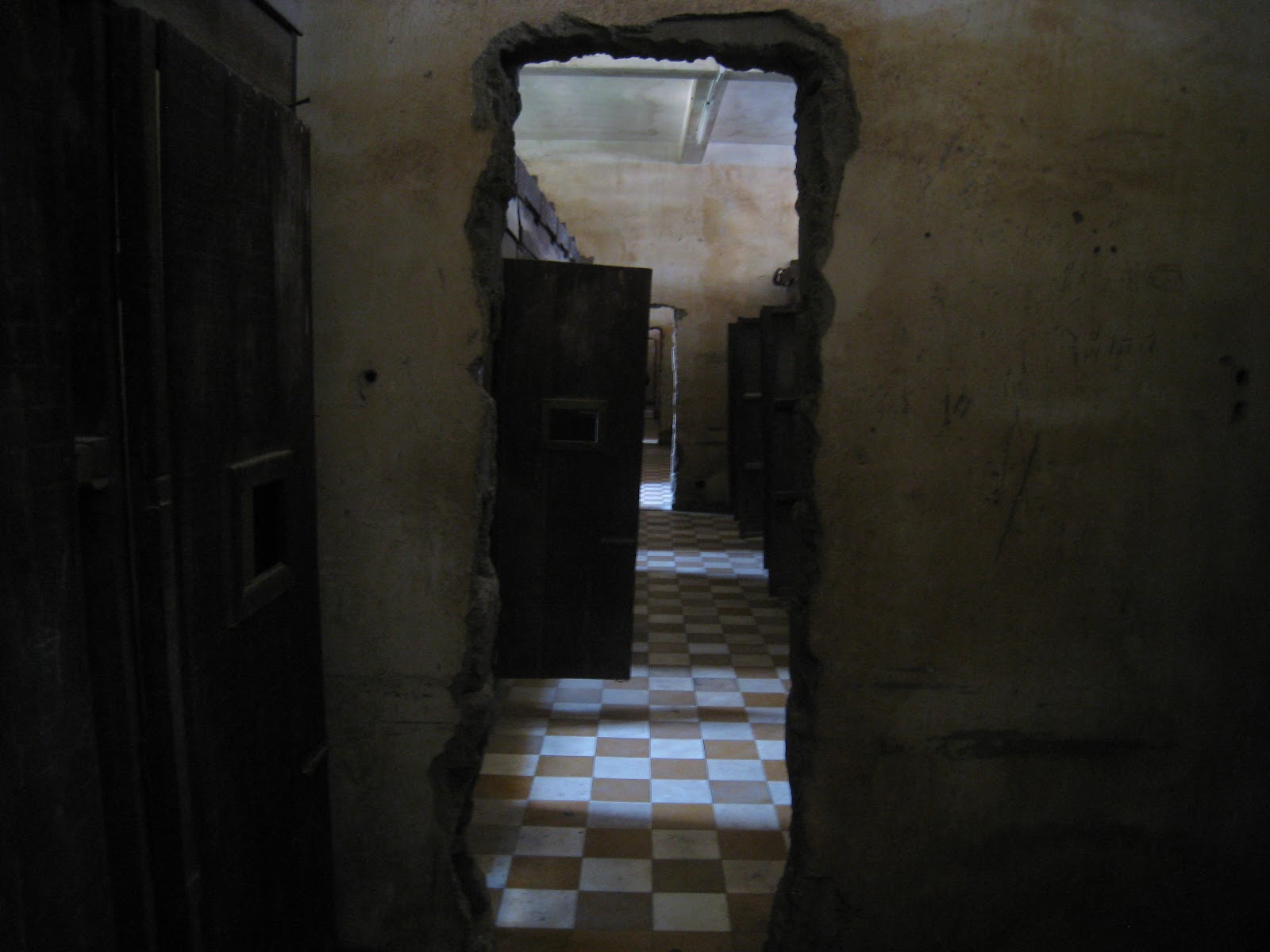
The prison has been left much as the Vietnamese army found it when they invaded Phnom Penh in 1979.  The rusty metal bed frames victims were shackled to remain as a silent, grotesque testament to the horrors that took place here.  In these rooms, photographs are displayed of the dead prisoners found by the Vietnamese, still chained to those same bed frames, tortured to death.  There are bloodstains on some of the floors and bullet holes in some of the walls.  Some rooms had more descriptions, including stories about some of the survivors of S-21, but the museum didn't need much explaining.  Living conditions were unfathomably appalling - the ramshackle wooden cells and the rooms where inmates were laid on the ground, harnessed together by metal rods binding their feet so they could not move or roll over with no mosquito nets and no padding between them and the hard floor - conveyed a sense of unprepared, unflinching brutality on the part of the Khmer Rouge.  The wooden cells especially sent chills down our spines.  Something about the warped, rotting walls brought finality and a gut-wrenching realness to the descriptions of the makeshift cells we had read about.

Much like the Nazis, the Khmer Rouge kept meticulous records of their atrocities.  A photograph was taken and a detailed file kept on every inmate that passed through S-21.  Hundreds of these photographs are displayed, without captions, on large boards throughout the museum, eerie images of the innocent lives lost.  Words could not have conveyed the horror and suffering caused by the Khmer Rouge as well as these photographs do.  The faces stared at us from the past and seemingly reached inside of us and stirred up a complicated range of emotions.  We both noticed that an expression or a particular set of eyes or smirk or a frown would catch our gaze, pulling our attention away from the hundreds of other faces.  Some expressions showed despair, while others showed anger or grief or sadness or strength or remorse or defiance (or all of the above).  The photos were immensely powerful, and looking at them was often difficult, but they are impossible to ignore.  They are impossible to keep away from your imagination, as you stand in rooms where people were tortured and killed in the name of fear and paranoia and ignorance.  They force your mind to reach back in time, to find the owners of these expressions and pull them up to the present as a startling reminder of what the human race is capable of, and that we must remain diligent to keep such things from happening again. 

We left the museum exhausted and drained.  Visiting Tuol Sleng was a moving experience, but our emotions while there and afterward were so many and so varied that we felt almost too tired for words.  We found respite in a leafy garden restaurant across the street.  The host politely asked how we were and when we told him we had just come from the museum, his expression immediately conveyed an understanding of what that meant.  He told us to sit down, relax, and said they'd get us water right away.  Without us saying anything about our experience to him, he knew how we felt after seeing visiting Tuol Sleng.   He knew that the contents of the museum were so horrible and raw that there was only one reaction - complete mental and physical exhaustion.

After lunch, we enjoyed a conversation with our friendly waiter, Sarat, whom we mentioned in our last post.  From where we sat, we could still see the barbed wire and imposing facade of Tuol Sleng, the grim memorial to Cambodia's gruesome past.  And here, happily conversing with us, was Cambodia's bright future.  Sarat could not have been older than 22, not so far removed from the terrible genocide inflicted by the Khmer Rouge and the years of civil war that followed, but his outlook was one of optimism and positivity.  This young man seemed to us to be the positive, smiling image of a new Cambodia.  To the young people we were privileged to meet in Cambodia, the years of the Khmer Rouge remain an important lesson in their history, but it does not define them. 

Although still devastatingly poor and racked by gross corruption, it is amazing to witness the modern bustle of Cambodia and the smiles of the faces of its citizens, knowing what events unfolded just 32 years ago.  Cambodia might still have a long way to go, but as far as it has already come, with young, motivated youth like Sarat, to us, Cambodia's future looks bright indeed.


Read more about Cambodia's recent history:
Yale's Cambodia Genocide Project - www.yale.edu/cgp
Khmer Legacies - www.khmerlegacies.org
Tuol Sleng Museum Website - www.tuolslengmuseum.com/History.htm
Tuol Sleng History (brief overview) - www.tuolsleng.com/history.php
Peace Pledge - www.ppu.org.uk/genocide/g_cambodia.html

Tuesday, November 29, 2011

Phnom Penh: Introduction to Cambodia

Over the last eight months many of our travel plans changed and morphed - we skipped Indonesia entirely, reworked our Japan itinerary, stayed twice as long as we had planned in Malaysia, added an extra month to Australia, and added a stopover in New Zealand.  Of course those are just a few of the changes to our plans; there were so many other smaller shifts and re-jiggerings while on the road it was sometimes difficult to remember the original plan, which usually stops mattering once you set off anyway.  A bus breaks down, you get kicked off a bus outside your destination unable to understand why, a city captivates you immediately, a city repulses you even more immediately.  Whatever the specific circumstances, real-life travel is rarely much like imagined travel at all.  And that is indeed one of the beauties of travel.  But one plan that remained un-fussed with and that we're glad about leaving alone, even though it would have been easy to squeeze out entirely because it was our last destination, was our decision to go to Cambodia at the end of our trip.  For many reasons, Cambodia has been the perfect place to end our journey.

We did not know much about Cambodia when first planning our time in SE Asia, but we knew enough about Angkor Wat and its surrounding, crumbling splendor to plan for at least one week in Cambodia between Vietnam and our flight home from Bangkok.  Now that we have been in Cambodia almost that full week, we can tell you that one week is not enough time to fully experience and appreciate the warmth and wonder that is the Cambodian people and spirit.  But for us one week is both perfect and necessary, as we are quite literally running out of time (something we didn't think was possible with eight months to work with) and looking more and more forward to seeing our friends and family as our flight home draws near.  We are also burning out, as bug bites, small ailments, and exhaustion have all beaten us into near submission.  We will hopefully come back to Cambodia to explore the path less trodden, which many other tourists skip (ourselves included) as they take about six or seven days to hang out in Phnom Penh and Siem Reap, just long enough to get a taste of the capital and thoroughly templed-out at the Angkor temple area.  Judging by the small, delightful taste we have gotten, we can imagine that if Cambodia had happened somewhere around June or July, or even August or September, we might have gladly tacked on an extra week or two!

Cambodia is a beautiful country that, despite it's difficult recent history, exerts a quiet, consuming energy that is surprising and infectious.  Our first stop, Phnom Penh, helped bring us closer to the country's culture, history and people, and we saw very quickly, even in Cambodia's largest city, some of the shining personalities Khmer people are famous for.  A waiter at one of our lunch-stops was so excited to talk with us and practice his English that he spoke with us for a good ten or fifteen minutes after we had finished and paid.  This was not a tip or any hospitality industry massaging.  This young man was genuinely interested in meeting us and learning about us.  He smiled and laughed and joked his way to getting our contact information so he can Skype with us when we're back home.  There was nothing but a real excitement to make new friends in his approach and discussions with us.  Beyond the language barrier, he was curious about us and what we thought about Cambodia (as well as the Toul Sleng Genocide Museum we had just visited, which will be the focus of our next post). 

PP is a city of over 1.5 million, but it feels a bit smaller - a la Vientiane, Laos.  There are many expats and tourists, as well as many busy roads and large buildings, but the city is laid-back almost to the point of lazy.  It is just a really easy city to be in, whether that means to live in, sight-see in, explore, or whatever you like.  Phnom Penh effortlessly becomes almost anything you might want it to be. Fancy restaurants and hotels for the snooty, really excellent and dedicated charities and NGOs (that help landmine victims, disabled Cambodians, and street youth find better lives using innovative and sustainable methods) for the giving, river-side bars and restaurants for the fun-loving.  Although cozy and friendly, PP has a lot to offer.


Also on offer, whether sought out or not, is an introduction to Cambodia's sad and often violent history.  Reminders are everywhere - from young children with landmine injuries begging on the street to museums grimly recounting the colonialism, civil wars, genocide, and upheaval that has rocked and divided Cambodia for the last 100 years.  PP can excite and horrify all within a matter of moments, but the emotional realities brought to light in PP are important to learn from.

PP captivated us, and we held our gaze for better and worse.  We stared and took note when PP surprised and warmed us with it's friendliness, culture, and big-city pleasures.  And we stared still, in a different way altogether, when PP terrified and disturbed us.  Undoubtedly and unreservedly, Phnom Penh introduced us to both sides of Cambodia - its dark, sad past, as well as its bright, hopeful future.

Wednesday, March 16, 2011

Maybe later, maybe now

I have wanted to travel Asia for a long time.  But I haven't yet.  I plan to remedy that on April 3rd.

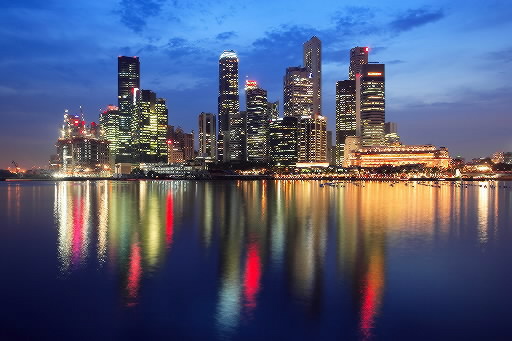
Singapore
A trip to Asia has always seemed like one of those "too-big" dreams.  Something fantastic to talk about, but too large and difficult to actually do anytime soon.  Maybe later, I kept telling myself.

As much as I talk about loving travel, I haven't been on an extended trip since 2007.  I went to Europe for two months with my girlfriend after college on the obligatory "go-to-Europe-before-real-life-starts-trip." And it was awesome.  It was a trip I would never take back. I learned a lot about myself, about the world, and about my future wife.  But it always felt safe somehow.  It felt like an escape more than an adventure for some reason.

Gulin, China
I pushed myself, but I never felt as uncomfortable as even just the thought of traveling in Asia makes me.

My girlfriend and I both started working almost as soon as we got back home.  Before we knew it almost four years had flown by.  It happens just like that. Zoom!

A lot happened in those four years - I bought a house, got married, went on an amazing honeymoon, made friends, lost friends, pursued a new career, and started a writing project.  But also in that time I started getting antsy again.  My wife and I started talking more and more about our future.  And the more we talked, the more we realized that we didn't have much time.  Our lives were getting more complicated each day, and the opportunity we were looking for - the opportunity to seemingly blow off our responsibilities here and flee the country - wasn't going to be around forever.

Indonesia
So, we quit our jobs to backpack around Asia and Australia. We are extremely lucky to be able to take this time to travel and we want to take you with us! This blog will detail our trip with words and photos.  I have no idea what this will all look like at the end of our trip but I hope it will allow you to travel along side us.

I hope you will enjoy following it!