Search J & A Abroad

Sunday, July 10, 2011

Beijing for Tourists, Part Three

Standing on the Great Wall has been one of the highlights of our entire trip.  (And it remains in the top five, if not the top three, up through the middle of July.)  We have met a few travelers who are not moved by the Great Wall.  It holds little interest for them.  Not us. We were quite moved by it - enough so that we got up at 5am our last full day in Beijing to catch our ride at 6am in an attempt to get to the section of wall at Mutianyu before anyone else.  It worked, too!  We had the wall to ourselves for nearly an hour (spotting only an employee and a woman selling drinks and snacks).  The first tourists we saw were a Chinese couple, the male half of which stopped to light a cigarette before ascending a steep stair case that was almost vertical! (The cigarette this gentleman lit is symbolic for how much Chinese males smoke.  Apparently smoking is viewed as manly, and you are less of a man if you don't.) The next two people we saw (also Chinese) wanted to stop and take photos with us. We never really felt crowded while on the wall and were quite happy in our decision to get up and tackle the it early.

During those first 45 minutes we both felt waves of joy and awe.  We stopped frequently for photos, but even more frequently to muse and discuss the amazement we felt, the energy and flood of emotion, from just standing on the Great Wall.  For us, the Great Wall was always a spectacular feat, a true wonder of the world,  that other people went to.  It was too far, and in a country too difficult to travel in, to be a realistic destination.  Our wall experience would have been less personal and far less powerful if we had shared it a few hours later with several thousand tourists.  It is selfish, but it is also true.  We got to the wall around 7:30 in the morning, and as hard as it was to get up while it was still dark out in order to accomplish our early arrival, it was far superior to the alternative - a lazy morning, a 10 am arrival, and having to compete with thousands of rabid tourists for the best photo op, the best view, and the next cable car.  Because we were alone on the wall we could take our time, while focusing less on framing photos to have as few other tourists as possible and focusing more on breathing in the epic struggle and years of toiling that made the Great Wall one of human kinds most amazing achievements.

The section of Great Wall at Mutianyu is great to visit for three reasons: 

1. It is less visited than the section at Badaling, which is longer and closer to Beijing.
2. Bill Clinton visited the Great Wall here and his red, sweaty face is blown up in several photos around the premises.
3. There is a luge course set up so that one can ride the cable car up (as we did) and sled down a hokey, but extremely fun luge track on the way down (as we also did).

Notes:
We hired a driver to take us to the Ming Tombs (another popular tourist destination just outside Beijing) and the Great Wall.  He was happy, polite, and really friendly.  He even pulled the car over on our way back so Jeff could jump out and find a toilet (there are tons of public toilets in China, which gets a big "like" from us, especial the man with a small bladder) when we were stuck in nasty Beijing traffic. Our driver's name was Gary and he made our trip to the Great Wall even better! (he also gets extra credit for showing up on time at 6am with a big smile and a full case of water in his trunk).

We met two young ladies from Seattle on the Great Wall(!).

The famous Beijing haze is as horrible as everyone says.  The worst smog we saw in China turned out to be in Chengdu, but the foggy pollution in Beijing still made L.A. look downright clear.  This terrible smog could be felt in our lungs and eyes, but it was also irritating when we went to the Great Wall and couldn't see much more than a kilometer or two.  Toxic haze should be hated for many reasons, but we found it most offensive for the way it ruined our great wall photos! (Not really.)

Saturday, July 9, 2011

Beijing for Tourists, Part Two

The Forbidden City, Tienanmen Square, and the Summer Palace are three of Beijing's main tourist destinations. We didn't do them all in one day, but the Forbidden City and the Summer Palace did seem quite similar in many ways.  The Forbidden City, though, had more secret police, enormous images of Mao, and tourist gaggles. The Summer Palace was even larger than the Forbidden City, though the latter usually gets recognition for being such a gigantic sight.  Indeed, there were gobs of tourists sitting and laying in any space with even a sliver of shade or a place to put one's rump.  We thanked our hours upon hours of temple-hopping over the previous five weeks for getting us into shape for the marathon that was the Forbidden City,  It was hot, crowded, and never-ending.  The sight itself is made up of hundreds of buildings, all clustered in different areas.  We visited gardens, bed chambers, temples, guest rooms, kitchens, and every other type of room you'd expect to find in one of the grandest palaces in Asia.  We felt good every time we passed a mass of resting bodies without needing a break.  We stuck to ice cream in the Beijing heat, enjoying our first (but not last) ice cream-lunch of the trip.  We saw jewels, recreated living quarters, jade sculptures, photos of later members of royal dynasties, and heard all about the history of the Forbidden City from our lovely audio guide.  There is definitely a difference between an audio guide voice who speaks English as a first language, and one that speaks it as a second.  For instance, it took us a while to figure out that every time the guide said "air-ee" she was really saying "area."

After a full day at the Forbidden City, we crossed the street to walk through Tienanmen Square. It is as big as they say and is supposedly teeming with secret police.  The not-so secret police, or plain clothed police, outside the Forbidden City were easy to spot, so we tried to pick them out of the crowd in the square.  Besides the size, the next two things that stand out about the famous square are the gigantic propaganda screen (playing a pro-China video on repeat that implied that China was the freest, most affluent, happiest, best-looking country in the world - all set to very inspirational music) and the dozens of cameras set to observe the square from every visible post and building.  The cameras were a blatant reminder that China is always watching, as were the two police vans parked behind the propaganda screen.  The whole thing felt very eerie, especially if you turned to face the massive painting of Mao quietly observing from its perch
across the street above the front gate of the Forbidden City. Actually, if you ever missed seeing Mao's face in China all you had to do was pull out any piece of paper money, since his mug is on every denomination.

The next day (after a fine meal at a less-traveled dumpling restaurant with PL and a family friend) we ventured to the Summer Palace. We didn't spend more than a few hours there because it was pretty similar to the Forbidden City, but the sheer size, grandeur, and elegant layout made us fans of it as a tourist stop.  We rode a boat across the (man-made?) lake, traipsed up and down hills and through old, often crumbling structures.  We often felt as though we weren't in a city at all, kind of like spending a day in Discovery Park, only the wildlife and beaches are replaced with scores of tourists, once-gaudy temples and old palace buildings, and many kilometers of paved and stone paths meandering around the lake, over the lake, and through all of the eroding splendor.


Highlights of these two days:


 Standing in Tianamen Square, thinking of the great and terrible history of the bricks under our feet.


Getting lost in the meandering maze that is the Forbidden City.


 Jeff running around the area surrounding the Forbidden City for an hour looking for a cash machine. We were shocked he had to go so far to find one, but it was, less surprisingly, located near a cluster of Peking Duck restaurants for tourists. (More on our Peking Duck experience in a few posts...)


Ice Cream Lunch!!

Oh, The Places We've Been!

You can view this page any time by clicking the "Oh, The Places We've Been" tab at the top of our blog!

Below are all of the cities we have been to and stops we have made since leaving Seattle on April 5th.  We will keep updating this as we travel so you can see where we were, and when.

Japan, April 5 - April 29
Osaka, 5 - 8
Mt. Koya, 8 - 9
Kyoto, 9 - 14
Nara, 14 - 16
Kanazawa, 16 - 19
Takayama, 19 - 22
Hirayu, 22 -23
Tsumago, 23 - 25
Hiroshima, 25 - 29

South Korea, April 29 - May 14
Busan, April 29 - May 2
Gyeongju, 2- 4
Andong, 4 - 5
Samcheok, 5 - 6
Seorak-Dong (Seoraksan), 6 - 9
Seoul, 9 - 14

China, May 14 - June 11
Beijing, May 14 - 19
Xian, 20 - 22
Shanghai, 22 - 25
Chengdu, 25 - 28
Kunming, 28 - 30
Dali, May 30 - June 1
LIjiang, 1 - 2
Tiger Leaping Gorge, 2 -4
Night Train to Kunming, 4
Guilin, 5 - 6
Yangshuo, 6 - 10,
Hong Kong, 11 - 15

Thailand, June 15 - June 28

Koh Samui, 15 - 16
Koh Tao, 16 - 28

Malaysia, June 29 - July 22
Georgetown, Penang, June 29 - July 2
Cameron Highlands, 2 - 4
Perhentian Kecil, 4 - 8
Kuala Terengganu, 8-9
Kuala Lumpur, 9 - 14
Melaka, 14 - 17
Singapore, 17 - 22

Beijing for Tourists, Part One


Staying with PL and family in Beijing made us feel like we were at home.  We saw things we wouldn't have gotten to see, tasted food we wouldn't have gotten to taste, and had a Beijing experience we just wouldn't have had otherwise.  But we also needed to do our tourist thing too. We hit the big Beijing sights, starting with a visit to the Temple of Heaven after the wedding on our first full day in the city. 

The Temple of Heaven is a group of Taoist buildings with great names like, "Imperial Vault of Heaven," and "Hall of Prayer for Good Harvests." The surrounding park was filled with dancing and lounging locals, tourists, and touts who wanted to take us on guided tours and frequently inquired if we had been to the Great Wall yet.  (After two days of non-stop offers for tours of the Great Wall, Jeff finally asked one lady, "What is this Great Wall thing, anyway?"  She was not amused, though she did turn around and walk away from us, which was the intent of the question).

We thought the temples of Japan and Korea had us totally templed-out, but new colors (gold-roofed everything!) and fresh architecture and symbolism in China revitalized our ability to appreciate temples.  At least for a day or two...  There were huge crowds and we found ourselves in heat and chaos simply not present in Japan or Korea.  We really enjoyed the impressive scale of the buildings.  Our visit was some time ago, so we'll let Wikipedia describe the Hall of Prayer for Good Harvests for us:

The Hall of Prayer for Good Harvests (祈年殿) is a magnificent triple-gabled circular building, 36 meters in diameter and 38 meters tall, built on three levels of marble stone base, where the Emperor prayed for good harvests. The building is completely wooden, with no nails. The original building was burned down by a fire caused by lightning in 1889. The current building was re-built several years after the incident.

Yep.  That pretty much sums up the coolest building there.  As for observations of our own, we mainly noticed things that we would go on to see more of later.  Some of these items include:

Our first encounter with the giant propaganda screens that show videos about (apparently) how great China is (we saw more of these at most major tourist sights in China).

This screen is in Tiananmen Square, and had a bunch of police trucks parked behind it

Our first encounter with the Chinese military, who also turned out to be at every tourist sight in Beijing, and often in other cities.  They were usually engaged in some activity, whether it be running around in full gear in the heat or following marching instructions.


"Remember: We are everywhere, always watching!"

Our first encounter with the popular pastime of dancing in public parks.  Other popular activities in Chinese parks include Mahjong, flying kites, Tai Chi, and drinking tea for as many hours as possible while moving as little as possible, smoking as much as possible (men only, usually), and talking as loud as possible.  There was often unexplained loud music, singing, and performances in parks.

Dancing!

People flying kites, like everywhere!!


El Kite!


"Look mom, no crotch!"
Our first encounter with with the completely foreign approach Chinese take to un-potty trained infants and toddlers (as well as fully potty trained kids).  First, we saw a young boy, probably 5 or 6 years old, run over to the side of the main, and totally crowded, walkway leading to/from the Temple of Heaven and take a pee on the edge.  We both chuckled,silently thanking him for not peeing directly on the walkway itself.  Even though he went off to the side, we were amused that he dropped his pants and peed in front of a couple hundred people.  We walked just a few more yards and saw a little girl, probably between 1 and 2 attempting to one-up him.  She was squatting in the middle of the same walkway apparently trying to poop.  Mom was right next to her. Actually, mom was encouraging and helping her!  She didn't actually succeed, at least as far as we saw, but we were amazed that pooping, even by a baby, would be OK in the middle of so much foot traffic.  We told PL about the little girl when we got back home.  She said, "Now you know why I asked you to take your shoes off when you come in my house!"

Extra note about baby and child bathroom etiquette in China:

PL went on to tell us that the public bathroom breaks for kids were totally common.  In fact, Chinese people mostly clothe their children in pants with little slits from the front to rear in the crotch region.  Diapers are not part of the equation.  Little kids are encouraged to poop and pee wherever and whenever the need strikes.  We saw a little boy of about four peeing off to the side of the sidewalk in Xi'an with such joy we couldn't help but smile.  He was holding his thing and twisting side to side with a smile as big as could fit on his little face.  We all should take such joy in using the bathroom!

We also saw a mom holding a small boy's thing while trying to get him to go in a raised tree-bed along a sidewalk.  We saw multiple acts of parent-encouraged peeing and pooping through those cute little pants slits that ranged from "hey, that is mildly inappropriate," to "someone will definitely step in that later!"  We also saw, as you can probably imagine, more baby butts (and other baby bits) than we ever, ever needed or wanted to.

The no-diaper, slitted pants approach led us to ask this very important question: "What happens when your baby decides to 'go' when being carried?"  We saw so many youngsters being carried around while outfitted in the slitted pants that things MUST get messy every now and again. The lack of trash and waste created by not using diapers gets a big "LIKE" from us.  The possibility of getting baby bathroom mess on you at any point in your day, on the other hand, gets a big "UNLIKE." Oh, and there is the little matter of leaving your baby's leavings in the middle of the sidewalk for others to discover.  Although neither of us "discovered" anything truly horrible this way (though we're sure we walked through human pee from humans of all ages A LOT in China), we found the "let the potty rest where it lies" attitude toward baby bathroom functions quite inconsiderate.  This would not be the only thing we would find inconsiderate about Chinese culture.  What appears inconsiderate to Westerners is often just the way things go in China.  People push, shove, yell (on cell phones during weddings), hack, spit, and smoke everywhere, and no one seems to mind.  The mentality is, and it makes sense in a way with so many people in one country and super-crowded cities, "You do you, and I'll do me." We will tackle this interesting aspect of Chinese society in upcoming China posts.

Up next:  Beijing for Tourists, Part Two!

Friday, July 1, 2011

China, We Meet at Last

We were fortunate enough to have someone to stay with in Beijing.  We stayed in Beijing for six days (five nights) and every one of them was made better because of the generosity and introduction to China we received from our wonderful hosts.  We stayed with a friend (we'll call her PL here) and her two daughters.  PL and her family (her husband was in Seattle on business, so we didn't meet him this time) have lived in Beijing for two years, so they knew the right places to take us for food, shopping, and unique cultural experiences.

PL picked us up from the Beijing airport and took us to her apartment near the center of the city via taxi cab.  For a number of reasons we didn't use cabs much in Japan or South Korea (though automatically opening rear doors on Japanese cabs impressed Jeff for the full three weeks we were there).  PL told us that Beijing cabs are a cheap and reliable way to get around the city and we used them quite a bit because of the introduction she gave us upon our arrival.  (That, and the handy Beijing taxi guide she lent us that had top destinations in the area written in Chinese, Pinion, and English.)  Cabs are more expensive than Beijing's very cheap metro system, but they are also quite easy to catch and often more convenient.  We used a combination of cabs and the metro to get around ol' Peking, but riding in Chinese cabs turned into one of the highlights of our entire month-long stay in China. We didn't know it at the time, but riding in and studying Beijing traffic was an excellent way to learn about and begin understanding Chinese culture. We'll dive into those observations more in future posts, but the important thing to note now is that PL taking us from the airport to her home in a cab, and encouraging us to use them to buzz around the city, helped open our eyes to an aspect of China and Chinese culture we might have otherwise missed.

Jeff shopping for DVDs
In addition to the gift of Beijing cab rides, PL and her wonderful daughters also introduced us to the glory of cheap massages and pedicures, several local restaurants we would have missed on our own, the utterly disgusting, must-try Chinese rice liquor (Baijiu), and the art of shopping (read: haggling) in China.  Neither of us are really bargainers or hagglers by nature. PL took us to a market not far from her house called Yashow on our first night in Beijing.  It was four floors of noise and haggling.  It wasn't the calm, relaxed shopping mall setting most Americans are used to (though there was one of those across the street, where everything was three or four times more expensive).  We tried some delicious street dessert from Tibet that we still don't know the name of, browsed insanely cheap (i.e. counterfeit--shhh!!) DVDs in a shop that looked as if it could be broken down in a moment's notice, and got terribly cheap massages on the top floor. We didn't do any shopping, but
Baijiu?  Ew!
Annette got her feet wet with the haggling we would come to enjoy by the time we left China when we returned to the market a few days later.  There was a certain shirt that almost every little shop offered in one area of the market.  On her first attempt , Annette was thwarted by a grumpy gal who refused to haggle with us below a certain price.  Presumably because she had a corner spot near the entrance, where green tourists probably pay her way too much for her items all day long.  Slightly discouraged, but still determined, Annette approached another vendor, got the price she wanted, and popped her haggling cherry.  We walked by the first gal defiantly, proud of ourselves and our first successful bargaining experience.

We enjoyed all of the hints, tips, and personal experiences PL and the girls shared with us, but one of the coolest gifts they gave us (besides a free place to crash for five nights) was taking us to the wedding of a friend.  We most certainly would have never experienced a Chinese wedding without the help of PL and the girls!

The Chinese (bride)/Korean (groom) ceremony and reception was held in a restaurant above a shopping mall. The wedding was most interesting in its informality and the excess of food. The ceremony started with a Jib-Jab video of animated salsa dancers with the faces of the bride and groom pasted on., the bride walked down the aisle to a song that we're pretty sure was a version of the Rocky theme song, and the music and the M.C. (yes, there was an M.C.--for the ceremony too!) stayed hilariously and heart-warmingly cheesy throughout.  Everyone does the wedding thing a little different, but the single biggest factor lending to the informal vibe was that the room stayed loud through the whole thing.  The guests talked boisterously during the ring ceremony, special guest speeches (yes, there were special guests:  the bosses of the bride and groom gave speeches during the ceremony!), and vows.  The whole room continued to smoke and talk as the wedding went on in front of them, seemingly uninterested in the ceremony itself.  There was even a dude on his cell phone during the vows.  No joke.  We found out later that it is typical for Chinese people to talk during entire movies in the theater, offer no applause after performances, and conversate at louder-than-normal volumes right through dance performances, operas, and plays. So the loud-talking, cell-phone using, drinking, smoking guests didn't seem to throw off the bride, groom, or the ceremony.  Just us!

We had read that Chinese banquets and dinners are supplied with far more food than the number of guests in attendance could possibly eat, because the host of the event suffers great shame if they do not provide enough food for their guests.  Clean plates mean the host is stingy, so they attempt to provide as much food as they possibly can in order to ensure a successful meal.  Our table of 10 received dishes including, but not limited to, one whole (large) fish, one whole chicken, half a pig, several salads, at least two soups, beef and seafood dishes, mixed variety Chinese dishes, several plates of desserts, noodle dishes, endless drinks, three packs of cigarettes, and several rice dishes.  A couple of teachers from the girls' school (the bride is a secretary there) sitting next to us were kind enough to help us determine some of what we ate, which helped us with the identification portion of the lunch-time feast but not with the shock of seeing so much food in one place.  There was probably enough food at our table for 20-30 people and not one dish was finished.  We would have still had way too much food even if we had Glen O. with us!  Now, the wastefulness of this approach to dining is undeniable. We also can't deny the effect bringing so much great looking, great tasting food has on two foreigners at their first real Chinese meal.  We were awe struck. Dumbfounded.  Jeff talked about the amount of food, and the tastiness of a few of the dishes, for days afterward.

 We went to a fabulous duck dinner with PL, the girls, and a friend of theirs for our last dinner in Beiing. And since we started our time in Beijing with the wedding feast, a duck feast seemed like the right way to end it.  Peking duck is a big deal in Beijing.  Peking duck is on most tourists' must-see list along with the Forbidden City and Tienanmen Square.  We would have ended up eating our Peking duck at one of the hundreds of overpriced, just-for-tourists duck places had it not been for, you guessed it, PL.  Instead of having a ho-hum fake duck meal with a gaggle of other tourists, we got the real experience at a place not far from PL's house, at a restaurant the father of a Chinese friend once told PL he considered to be one of the best in Beijing.  We ordered WAY too much food to go along with our duck, but when we looked around the room
The duck man carveth
we realized we fit right in.  We had noticed just after sitting down that the restaurant was loud.  Not just kind of loud, or noisy.  But really, really loud considering the number of people in it.  Once we ordered and began getting more comfortable, we noticed that every table had a mountain of food on it.  Every single table had a duck, or two, but each group also had so many extra side dishes we thought we were back at the wedding. Upon opening the menu, which was half as thick as the Bible and had mouth-watering photos of just about every dish, we understood how food could stack up  in such a tremendous way on the tables around us.  And soon, it did on ours too.

The wedding, the shopping, the tips, and fascinating stories about adapting to and living in Beijing made staying with PL and her girls one of the best decisions we've made on our trip.  It is really eye-opening to experience the warmth and kindness of others in this way. Our following three weeks bouncing around the rough, abrupt land of China would prove that having that family atmosphere first thing when we arrived was a very, very good thing!

Wednesday, June 22, 2011

A Trippy Trip to the DMZ

The Demilitarized Zone (known as the DMZ) between North and South Korea is one of the strangest places either of us have ever visited. The boarder between South and North Korea is one of the most heavily fortified and militarized borders in the world, yet various tour companies (including the USO, who we went with) shuttle hoards of tourists there every day.  The tension is thick, with violent incidents and fairly frequent acts of aggression and terrorism still lingering in the air, just a few years past.  Republic of Korea (R.O.K.) and U.S. soldiers stand ready on the South Korean side of the boarder, making fun of the Korean People's Army soldiers (K.P.N.) yards away in North Korea as nervous tourists laugh and snap photos.  Both sides record each other with cameras mounted everywhere, remodel buildings in attempts to out-do one another, and maintain strict rules (like no pointing - one guy on our tour got yelled at for pointing at the North Korean side) regarding behavior around the border.

Not far from the Joint Security Area (the J.S.A), where tour groups flock and delegates from the U.N. try to keep things peaceful, there is a train station connecting the North and South.  It seems to have been built mainly for publicity.  George W. Bush went there to commemorate its opening, but no train has passed from one side to the other.  The train station stands new and shiny, a propaganda ghost boasting of a brighter future, where the two sides are re-united by this glorious transport hub.  For now, it just stands mainly empty - a creepy and eerie shell, waiting for passengers that will likely never come.  The station even has security stalls with conveyor belts and metal detectors set up for the day when trains can once again cross the border.  The station looks brand new, but oddly feels like a ghost town.  You can even pay to go down to the platform and look at the unused tracks.

in North Korea w/ROK soldier
There are also small border towns on each side near the JSA.  The South's town is populated by relatives of villagers displaced during the Korean war over 50 years ago.  The North's town is, according to the South, populated by no one and made to look really great, though it is entirely empty.  At one point, South Korea's town put up a flag pole and the North quickly put up a taller pole with a larger flag to show them who is boss.  North Korea's town is called "Propaganda Village" because they used to blare anti-South and pro-North propaganda over loud speakers up to 18 hours a day.

A real, live North Korean!
Our tour visited a tunnel dug by North Korea as well.  The tunnel is one of four that have been discovered so far.  Every time one of these tunnels is discovered, North Korea has a new excuse.  The one we visited had black rocks, which were painted so the North could claim that it had been mining for coal.  Upon being confronted about one of the other tunnels, the North simply blamed the South, claiming that they had built it.  This seemed to us a little like passing gas in an elevator with one other guy, turning to him and saying, "You did it." Classic.

The bus loads of tourists visiting the JSA, the empty train station and the tunnels combined with the seemingly childish antics of both sides (the flag pole war, and drawn out arguments involving the tallest building in the JSA, and more) make a very dangerous situation feel very bizarre.  Three American and R.O.K soldiers were killed in the late 1970's when they were attacked by North Korean soldiers after attempting to chop down a tree obstruction their view of other observation points. A few days later the tree was cut down while air support and an aircraft carrier of the coast of South Korea provided cover.  We also learned about several fairly recent acts of terrorism, the plight of North Korean refugees, and broken families.  There is a grave and heartbreaking rift between North and South Korea.  The fear and anger and hatred is very strong, but the DMZ does feel a little like Disneyland with machine guns. The souvenir shops were the weirdest part, as they peppered every stop on our tour and carried everything from North Korea beer (what, no embargo?) to little US army fatigues for infants.

We had been told that you have to go to the DMZ to believe it.  And we didn't plan to go at first.  We thought it would be too dangerous, since all either of us have ever heard about it were the acts of violence and the extreme tension on both sides. But it was really powerful, disturbing, somewhat comical, emotional, and frightening all at once.  It was truly unlike anywhere we have ever been.

Wednesday, June 8, 2011

Seoul: Good For the Soul

It is true, we get by with a little help from our friends.  In this case, our five days in Seoul were greatly improved, and many difficulties eased, because of our friend LC.

Jeff and LC had a class together in college, and she was kind enough to reach out when she found out we were coming to Korea.  Months before we came to Seoul she offered to show us around, and she did not disappoint when we finally did come to town.  Her kindness took the form of a night out to sample the Seoul nightlife and a full-day tour of the city the following day.

LC has lived in Korea for the past four years teaching English and had a lot of observations, experiences, and perspective to share. Our first night in Seoul we met up with LC and some of her friends for dinner, drinks, and dancing. We learned a lot about Korean culture, through the eyes of Westerners.  We talked at length about their views on education, plastic surgery, social pressures, and dating a Korean as a Westerner. Dating sounds fraught with issues and almost too complicated to enjoy - as parental pressure to wed before age 30 is extremely high.  We had noticed plastic surgery ads and offices all over the place in Korea, especially in the big cities.  LC and her friends confirmed that plastic surgery was routine in Korea, noting that Korean women they had worked with had mentioned that they were going to have bone shaving to make their face thinner, or an eye-lid procedure to create a more "Western" look in a few days as nonchalantly as we might mention a trip to the beach or the purchase of a new shirt. The societal pressure to fit a certain standard of beauty, whiter skin, thin face, wide eyes, etc., is HUGE in Korea, according to the LC and her friends.  Two of her friends are Korean Canadians and they had a unique perspective on Korea.  We really enjoyed the whole evening - as dancing and late night drinking binges are not usual for us at home or abroad - and felt the short time with LC's friends helped us discover (second-hand) aspects of Korean culture we never would have seen.

The following day LC took us around Seoul for no less than 9 hours.  We met up with her just after lunch and left her long after the sun set and we had enjoyed some coffee and pastries.  She took us to Gyeongbok-gung [경복궁,景福宮] (the most famous palace in Seoul), a wonderfully artsy and alternative neighborhood called Insadong, to a traditional Korean tea house,  the magnificently romantic and charmingly refurbished Cheonggye Stream park, and to a great dinner.  We had more enlightening and interesting conversations with LC throughout the day, and left her that evening happy, well-fed, and better cultured.  We would not have been able to truly experience Seoul without LC!  We walked and took the subway so we also saw a lot of downtown Seoul on the LC tour.  We suggest you take it if you are ever in town!

The next day we continued to get over tummy troubles, saw the second most famous palace in Seoul, ate a comforting BK lunch, and found ourselves drawn back to Insadong.  There is a three-story building in Insadong where almost all the shops sell super awesome handmade items.  We nearly bought these cool and unique (and very heavy) clay tigers.  We may buy them if they are still there when we go back to Seoul during our 12 hour layover between Bangkok and Seattle in December!


Our five days in Seoul presented us with the big-city version of Korea.  We saw a young man too drunk to walk or do anything outside of a club when we went out our first night.  We attended a Catholic mass (in Korean) in a very gothic and out-of-place looking brick church.  We ate an over-priced waffle and ice cream with kanoodling young Koreans in Insadong (apparently, Koreans love to go out for coffee and sweets - one need only walk down a major street in any city and note the Seattle-like proportions of coffee shops for proof). We danced and drank with Westeners and Korean-Canadians in the most happening neighborhood in Seoul (this included drinking at a very Capitol Hill-like bar called Vinyl, where all drinks are served in plastic bags with straws--think adult Capri Suns). We saw Korea's two most revered palaces, and held hands along its favorite new/old park.  We watched a very touristy, and very entertaining, changing of the guard at the Palace we went to with LC.  We left Seoul feeling like we had just visited one of the world's best cities.  We left Korea feeling like we had discovered a less-traveled jewel in a modern world where most amazing countries are totally pillaged and overrun with tourism and tourists.  If it wouldn't ruin the gem that is Korea, we'd tell you to go there.  So, shhhhh.


Notes

We stayed at a unique and slightly bizarre guesthouse in Seoul.  The location was fabulous!  The concept perfect.  The guesthouse was, in reality, kind of a bummer.  It was called Mr. Kim's Friends Guesthouse. Mr. Kim is a younger man with a dream:  He wants all of his guest to feel like they are at home.  He even has a bed in the front room and routinely fell asleep in the common areas out of apparent exhaustion. The common areas at Mr. Kim's felt awkward because they were so cramped and cluttered.  Our room was fine, but the noisy. Coming down the stairs around noon to a sleeping person in the bed in the front room was a bit uncomfortable.  And, although we applaud Mr. Kim's dream, we never felt liking hanging out in the common areas because doing so made us feel as though we were invading his (and possibly his family's) privacy.  We noticed a small, typed sign on the front door practically pleading for a new staff member to help out, and all we had to do was take one look at the totally tuckered Mr. Kim to tell that his dream was waring him out.  We wish Mr. Kim the best of luck, but can't recommend his place to any light sleepers or those with more sensitive sensibilities.

Our day-trip to the DMZ turned out to be a strange and fascinating thing.  The next post on our blog will be a quick re-cap of our visit to the DMZ.

Tuesday, June 7, 2011

Seoraksan National Park

Our two week South Korean stint was designed to start in Busan (on the Southwest tip of the peninsula) and swing us north, up the east coast hitting stops along the way before cutting west across the country to Seoul. Our destinations between Busan and Seoul were mostly small cities and towns with points of interest - the largest cave in South Korea, the penis park, temples, burial mounds, palaces, and the like. Our last stop before Seoul was the one we were most looking forward to:  We planned to stay three nights in a small town, Seorok-dong, just outside of one of Korea's favorite national parks, Seorksan (pronounced so-rock-san). Hiking is Korea's unofficial national passtime and after seeing photos from Seoroksan, we knew we had to go.  South Korea is still off the beaten path for most Western travelers, but the ones that do come to Korea come for the hiking.

We knew Seoraksan would be a little more difficult to get to than other destinations we had visited.  And our journey did turn into a mini-adventure.  We took a bus to a larger city outside of the park, planning to catch a smaller local bus to Seoraksan and our guest house there, the Seoraksan Morning Inn.  We ran around in the rain for a while trying to determine which bus to take to Seorak-dong and from where.  Luckily, we spotted some other white-folk with backpacks and instinctively gravitated toward them.  The hope in this move is always that the Westerners in question will be going to the same place and might know better what they are doing.  These particular backpackers had the good fourtine of running into an English-speaking local, eager to help them.  Their guide was able to help them, then us, to the correct bus stop and onto the right bus.  We chatted with our fellow travelers (actually, kind of a rare sight in Korea where most Westerners we had seen had been English teachers, ex-pats, and military personnel) during the bus ride.  They were two younger German guys who had just graduated high school.  Their trip sounded like a lot of fun - from Dubai to South Korea - and they had much to say in favor of couch surfing.  Easily the best quote from them was when one said, "We love to paw-tay!" This phrase, spoken with a German accent, made Jeff's day.  Deliiight-fuuulll!

We rolled off the bus after about an hour and parted ways with the Germans.  They went to their clearly marked Garden Inn, while we stumbled around for 5 or 10 minutes in search of the much harder to find Morning Inn.  We finally found it and it was far creepier than the photos on their website.  Massive and about 20 years past its prime, it looked like something our of The Shining.  Our room was one of the crustiest we had stayed in up to that point.  Howie Mandel could not have spent five minutes in it.  It was dark and we were tired.  The inn didn't appear to have any other guests at first, though we later heard some people yelling in the parking lot and could make out one girl shouting repetadly, "Fuck America! I fucking hate America!"  She sounded to us to be American herself, but clearly she loved to party.  The combination of the awkward owners, the apparence of the inn, the seemingly empty town populated only by mist and dim street lights, and the grungy room left us felling a little uncertain about our surroundings.

The next morning we woke up to blue skies and the bright, shining sun.  There was a marvelous peak visible from our room and that along with the clear weather and singing birds lifted our spirits considerably.  We went to the tourist office and found that we were about a week from the full opening of the park.  There were only a handful of hikes available from the Seorak-dong side of the park.  The first thing we noticed was that although Seoraksan had the most white people we had seen in South Korea, Korean's seemed most in awe of our whiteness.  We were approached the most for introductions and conversations in Seoraksan.  We even caused a small backup on the main road to the park when we stopped for breakfast on the second day.  Several cars in a row slowed as the drivers and all passengers ogled us.  We're talking serious rubber-necking here.  Heads turning as the vehicles rolled past us. Just inside the park on the first day we joined Korean tourists in taking photos of a  bear-and-cub statue when Annette was mobbed by a gaggle of little girls.  One came right up to her and handed her a flower. The girl was beaming.  "Hello! Hello!" they all shouted in a cute chorus.  Annette felt like Lady Gaga surrounded by her fans!  One of the little girls called out, "How are you?"  "I'm fine," Annette replied. "How are you?"  One little girl said "Good." Another said, "Fine." And another chirped our favorite response, "I'm unbelievable!"  This was the "We love to party" moment of the day!


Jeff had declared less than two weeks before Seoraksan that our hike on Miyajima was one of the most memorable of his life.  Two of the three hikes in Seoraksan easily blew Miyajima away.  One of the best parts of hiking in Korea was noticing all of the little differences between how Koreans hike and how Americans hike.  First, the outfit is of great importance.  Korean cities are crammed with hiking shops filled with neon coats and black pants.  This seems to be the national hiking outfit of choice.  Many people we encountered had this outfit, along with fancy backpacks, hats, hiking poles, and cool sunglasses.  Curiously, other people, mostly younger, but not always, chose high-heels and mini-skirts or jeans and tennis shoes. Some hiking trails demand little more than this sort of clothing, but the first two hikes we took in Seoraksan certainly demanded more.  The trails were mostly paved lain with stone, but when it came to gaining altitude wooden and metal staircases are built straight up hills and mountains.  These were the second and third major differences between hiking in America and Korea. At home, trails are mostly maintained dirt with bridges or wood used only when necessary.  In Korea cement is utilized liberally, and switchbacks are scrapped for steep staircases.  The first hike we took ended in almost two kilometers of metal staircases ascending straight up a sheer rock face.  The hike was difficult, the stairs bizarre, and the pay-off, to quote our little friend from earlier in the day, was "unbelievable!"  Getting to the top of the rock we climbed would have been impossible without advanced climbing gear and experience.  Once at the top, some dudes had set up a generator and were snapping photos for quick printing and selling.  Cold drinks were also for sale.  You see, the metal work didn't stop with the stairs.  The top of the hike culminated in two levels of metal platforms for celebrating and photo ops.

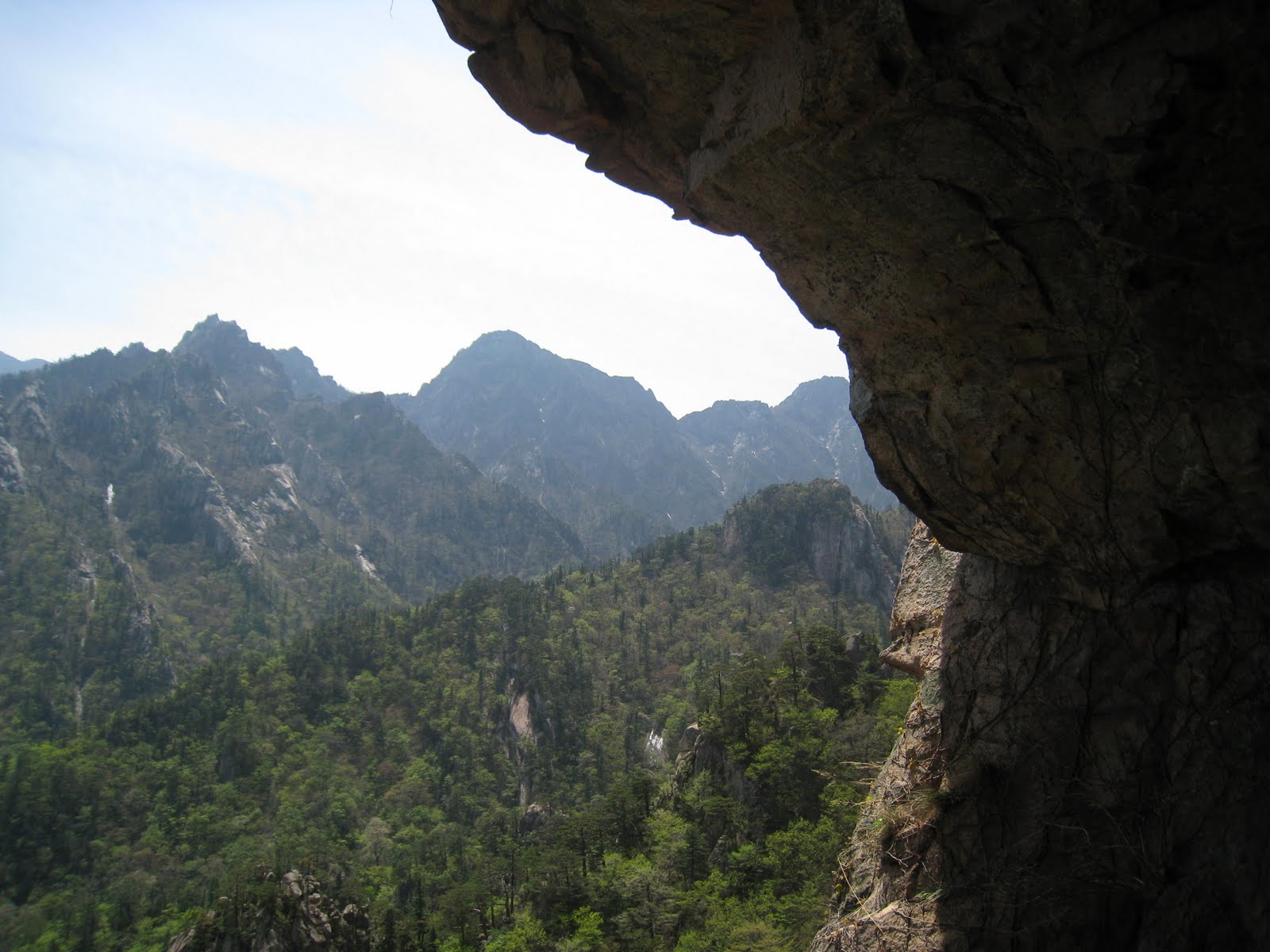
The big hike of the day left us just enough energy for a swinging cable-car ride up an opposite peak in gusting wind.  We hoped to watch the sunset from the top, but the harsh wind sent us back before the act was completed.  We did get to see more than a few folks in inappropriate attire scramble around the rocks.  You haven't seen comedy until you've seen a gal in high-heels and short skirt try to walk up a 60-degree hill in the wind.  We planned to tackle the two remaining hikes, a climb up a rock face to a cave and another to a waterfall our second day. We went for the cave first, since it promised to be more difficult.  It had portions as steep as our hike the day before, but was (thankfully) much shorter.  The cave turned out to be a temple with amazing views.  Peering out of the hole at the surreal mountain scenery outside was a spiritual experience for Jeff.  Annette's spiritual experience was catching her breath and drinking some water.

Luckily, the hike to the waterfall was pretty tame.  The waterfall itself wasn't breathtaking, but the hike and the fall were both pretty.  The flat and laid-back nature of the trail were heavenly! We slept well that night, as we had the night before, after showers in the a shower so unclean that you literally have to have just finished a hot, sweaty day of difficult hiking to use it. The next day we got up early and caught a bus to another bus to Seoul.  We left sore and happy.  Korea, we salute your strange and incredible hiking traditions!


Click HERE for more photos of Seorksan National Park!

Wednesday, June 1, 2011

Penis Park

Nearby the South Korean town of Samcheok is a small fishing village with a funny superstition.

The lighthouse is a ding!
Folk-lore in this village has it that a young virgin drowned on a small island off the coast. Her ghost haunted the village, causing bad fishing hauls.  A fishermen concluded that exposing himself to the sea while fishing would appease the dead virgin's ghost. Naturally, this plan worked and good fishing hauls returned to the village.  The fishermen of this village began exposing themselves every time they sailed and good hauls continued. At some point the fishermen tired of constantly exposing themselves to this virgin ghost and they started carving penises to decorate the cliffs overlooking the ocean instead.  Over time this turned into an annual penis-carving competition, and now there is a whole park, called Haesindang Park, filled with penises above this small town.

This place has every type of penis you could imagine. Small. Large. Fat. Skinny. There are Penis animals, penis water cannons, penis benches, and, of course, dozens of wooden carved penises left over from past contests.

The benches are dings!
We enjoyed this park because there were locals and tourists, young and old folks, all enjoying this utterly amusing forest of phallus. Delightful!

And actually, this park is just a symptom of what seems to be a national obsession.  Korea is a men-first sort of society, and many believe stamina (in bed, of course) to be very important.  There was a global Ginsing expo in Seoul when we were there and other foods, such as live octopus, are consumed under the belief that they are good for stamina.  Our friends in Seoul confirmed Korea's fascination with penis, though the penis park is all we needed.  Gaggles of giggling middle-aged men and women snapping photos posing with the many members and small children running around below the towering wangs provided priceless moments!

Check out our Samcheok Picasa album for more penis priceless-ness!

Everybody say, "Ding!"


Don't look up little fella!!